
Most people never question which paint they grab off the shelf. If the colour looks right and the price is fair, that tends to feel like enough. But the difference between interior and exterior paint goes far beyond the label on the tin.
These two products are chemically distinct, each built for entirely different conditions. Use one in place of the other, and you will be repainting within months.
Our experts at SDM Interiors have repaired the consequences of this mistake more times than we would like, and this guide covers everything you need to get it right.
What Is Paint? The Four Core Ingredients in Every Tin
Before we get into the differences, it helps to know what paint actually is. At its core, every tin of paint contains four ingredients, and each one plays a specific role in how the paint behaves, how long it lasts, and where it can be used.
The four building blocks are:
Pigment
This is what gives paint its colour. Pigments come in two main forms. Organic pigments are carbon-based and produce brighter, richer tones, but they degrade faster when exposed to sunlight.
Inorganic pigments are mineral-based, more muted in tone, but far more stable over time. Exterior paints rely on inorganic pigments for exactly this reason.
Resin (Binder)
The ingredient that holds the pigment to the surface and forms the dried paint film. It is the most important factor separating interior paint from exterior paint, and we cover it in detail shortly.
Solvent
What keeps the paint fluid enough to apply? In water-based paints, the solvent is simply water. In oil-based formulations, mineral spirits or white spirit is used. As the paint dries, the solvent evaporates and leaves the resin and pigment behind on the surface.
Additives
Specialist ingredients added to improve specific performance properties. Fungicides, UV stabilisers, biocides, thickeners, and anti-foam agents all fall under this category. The additive blend is what separates a basic white emulsion from a professional-grade exterior masonry paint.
Now that you know what goes into a tin, it is much easier to see why the same four ingredients can produce two completely different products, and what each one is actually built to handle.
Key Difference Between Interior and Exterior Paint
The difference between interior and exterior paint comes down to what each product has to survive. Interior paint lives in a controlled environment.
It faces finger marks, steam, pets, and regular cleaning. Exterior paint has to handle rain, frost, UV exposure, temperature swings, and biological growth like algae and mould.
These different demands mean manufacturers formulate each product specifically for its environment. The resin type, the additive blend, the pigment chemistry, and the VOC content all differ significantly as a result.
Here is a side-by-side overview:
| Property | Interior Paint | Exterior Paint |
|---|---|---|
| Resin type | Rigid, hard-wearing | Soft, flexible |
| VOC content | Low to zero | Higher |
| UV resistance | None | Yes — UV stabilisers added |
| Fungicide/biocide additives | Rarely included | Yes — standard |
| Washability | High — built to scrub | Moderate |
| Finish range | Wide (matt to high gloss) | More limited |
| Curing requirement | Cures without sunlight | Needs UV and light to cure fully |
| Typical surfaces | Plasterboard, plaster, timber | Masonry, brick, render, timber |
Each of these differences matters in practice. The following sections break down the most significant ones properly, starting with the ingredient that accounts for most of the gap between the two products.
Here is a breakdown of the interior painting cost.
Paint Finishes: What Interior and Exterior Paints Offer
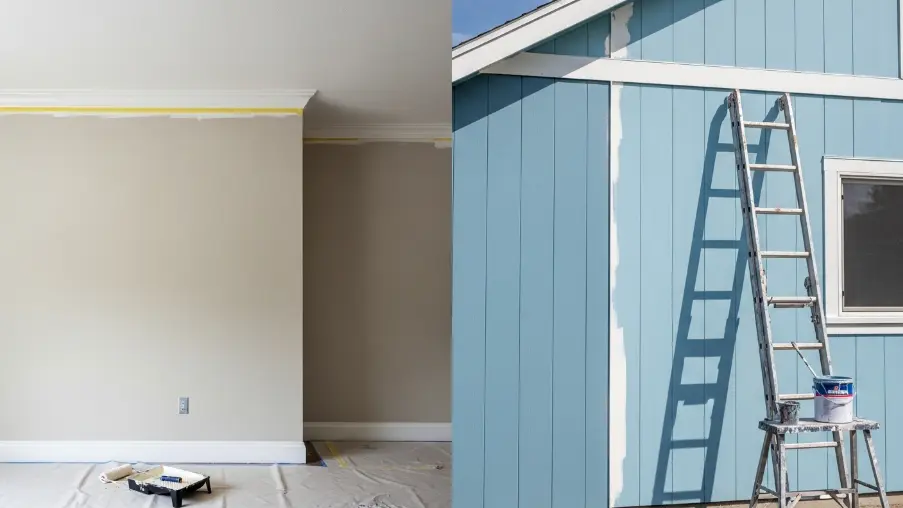
The finish on a paint determines how light reflects off the surface once it has dried. Matt surfaces absorb light. Gloss surfaces bounce it back.
The choice of finish affects both the look of the wall and how easy it is to clean. Both types of paint offer a range of finishes, but the options are not identical.
| Finish | Interior | Exterior | Best Used For |
|---|---|---|---|
| Dead Matt / Flat | Yes | Rarely | Feature walls, low-traffic rooms |
| Matt | Yes | Yes | Ceilings, bedrooms, living rooms |
| Eggshell | Yes | No | Interior woodwork, moderate-traffic walls |
| Silk / Satin | Yes | Yes | Hallways, kitchens, exterior timber |
| Semi-Gloss | Yes | Yes | Skirting, doors, exterior trims |
| Gloss | Yes | Yes | Doors, railings, high-use surfaces |
| Masonry / Textured | No | Yes | Brick, render, and concrete external walls |
Interior paint offers the widest range of finishes because aesthetics and ambience matter more indoors, and surfaces are smooth enough to hold anything from a dead matte to a high gloss.
Exterior paint focuses primarily on performance and weather resistance. This is why flat and dead-matt options are rare for outdoor use. They trap dirt and absorb moisture more readily, which compounds maintenance problems rather than reducing them.
Eggshell is worth a specific mention.
It is one of the most popular finishes for interior walls and woodwork in UK homes, offering a subtle sheen that is easy to wipe down without appearing too shiny. It has no real equivalent in exterior paint, and people sometimes try to use interior eggshell outside on garden furniture or window frames, where it quickly fails.
Can You Use Exterior Paint Indoors?
Technically, you can open a tin of exterior paint and apply it to an interior wall. Nobody will stop you. But there are compelling reasons why you should not, and they go beyond just a poor finish.
The VOC issue is the most serious concern. Exterior paint off-gasses chemicals that are safe and harmless outdoors because they disperse immediately into the open air. Inside a room, those same compounds accumulate.
The effects range from unpleasant to genuinely harmful, particularly for anyone spending extended time in the space. Painting a bedroom or a living area with exterior paint is not a risk worth taking for any savings.
Performance is the second reason to avoid it. Exterior paint contains soft, flexible resins built to handle outdoor thermal stress. On an interior wall that never sees those conditions, the film is softer than it needs to be.
It scuffs more readily, picks up fingerprints more easily, and is considerably harder to clean than a proper interior emulsion. The result is a wall that looks tired within months of painting.
The curing process is also a factor. Exterior paints are formulated to cure with the help of UV light.
In a room with limited natural light, the paint may never fully cure. The surface remains slightly soft and tacky, leading to early peeling and the need to repaint far sooner than expected.
If you have leftover exterior paint and absolutely want to use it somewhere indoors, a well-ventilated garage with masonry walls and no regular human occupation is arguably the only scenario where it is remotely acceptable. Anywhere else, it is a false economy.
For more in-depth knowledge, you can read this guide on the exterior painting procedure.
How to Choose the Right Paint for Your York Property
York’s housing stock is largely Victorian and Edwardian, with exposed brick, sand-and-cement render, and in older properties, traditional lime render.
Each surface type behaves differently, and each one needs a specific paint specification to perform properly over time.
External Masonry Surfaces
For external masonry, a breathable exterior masonry paint is the right choice. Breathability matters because walls, particularly older stone and brick properties, hold moisture that needs to escape.
A non-breathable coating traps that moisture behind the film, which causes blistering and, in some cases, frost damage to the masonry itself during winter.
Dulux Weathershield, Sandtex, and Johnstone’s Stormshield are well-regarded options for UK conditions. For lime-rendered properties, a lime-compatible exterior paint or limewash is the better choice, as these surfaces require a highly breathable coating to function correctly.
Interior Walls by Room Type
Matt emulsion suits bedrooms and living rooms well. These are lower-traffic spaces where the flat finish creates a clean, calm look and minor surface imperfections are less visible.
For higher-traffic areas like hallways and children’s rooms, a washable silk or satin finish is considerably more practical.
Kitchens and bathrooms need a moisture-resistant interior formulation. Standard emulsions are not designed to handle steam and condensation over time.
Timber and Metal
Timber requires primer, undercoat, and a gloss or satin topcoat, either oil-based or water-based, depending on the condition of the substrate and the level of exposure. External timber faces significant UV and moisture stress and needs a flexible, durable coating to last.
Metal surfaces require a rust-inhibiting primer before any topcoat, regardless of whether they are inside or outside.
If there is any doubt about the right product for a specific surface, a brief conversation with a professional painter and decorator will save considerably more money than it costs. At SDM Interiors, we survey the surface, specify the right product, and carry out the work properly from the first stroke.
Need a Flawless Finish? Let SDM Interiors Handle Your York Decorating Project
Getting your painting project right requires more than just picking the perfect colour. Because interior and exterior paints are engineered for completely different environments, using the wrong product can lead to peeling, cracking, or toxic fumes inside your home.
At SDM Interiors, we cover the full range of painting and decorating work across York and North Yorkshire, for residential and commercial properties alike. Our services include:
- Interior Painting and Decorating: From feature walls to full-property emulsions, we specify and apply the right product for every surface and room type.
- Exterior Painting and Decorating: Including masonry, render, timber, and metalwork across York and North Yorkshire.
- Property Maintenance York: Full-scale property updates, including surface preparation, repairs, and redecoration.
- Damp and Mould Solutions: Identifying and treating the root cause of damp and mould before any painting or decoration work begins.
Final Thoughts
The difference between interior and exterior paint is not a marketing distinction anymore. It is a chemical one, and it has real consequences in practice. Both products share the same four core ingredients, but what the manufacturer does with those ingredients determines everything about how the paint performs, how long it lasts, and whether it is safe to use in a particular environment.
Get the specification right, prepare the surface properly, and use a quality product, and a paint job can last a decade. Get it wrong, and you will be back to square one within a season.
If this guide helped, share it with someone planning a painting project. For any painting and decorating work across York and North Yorkshire, our team at SDM Interiors is always happy to advise.


